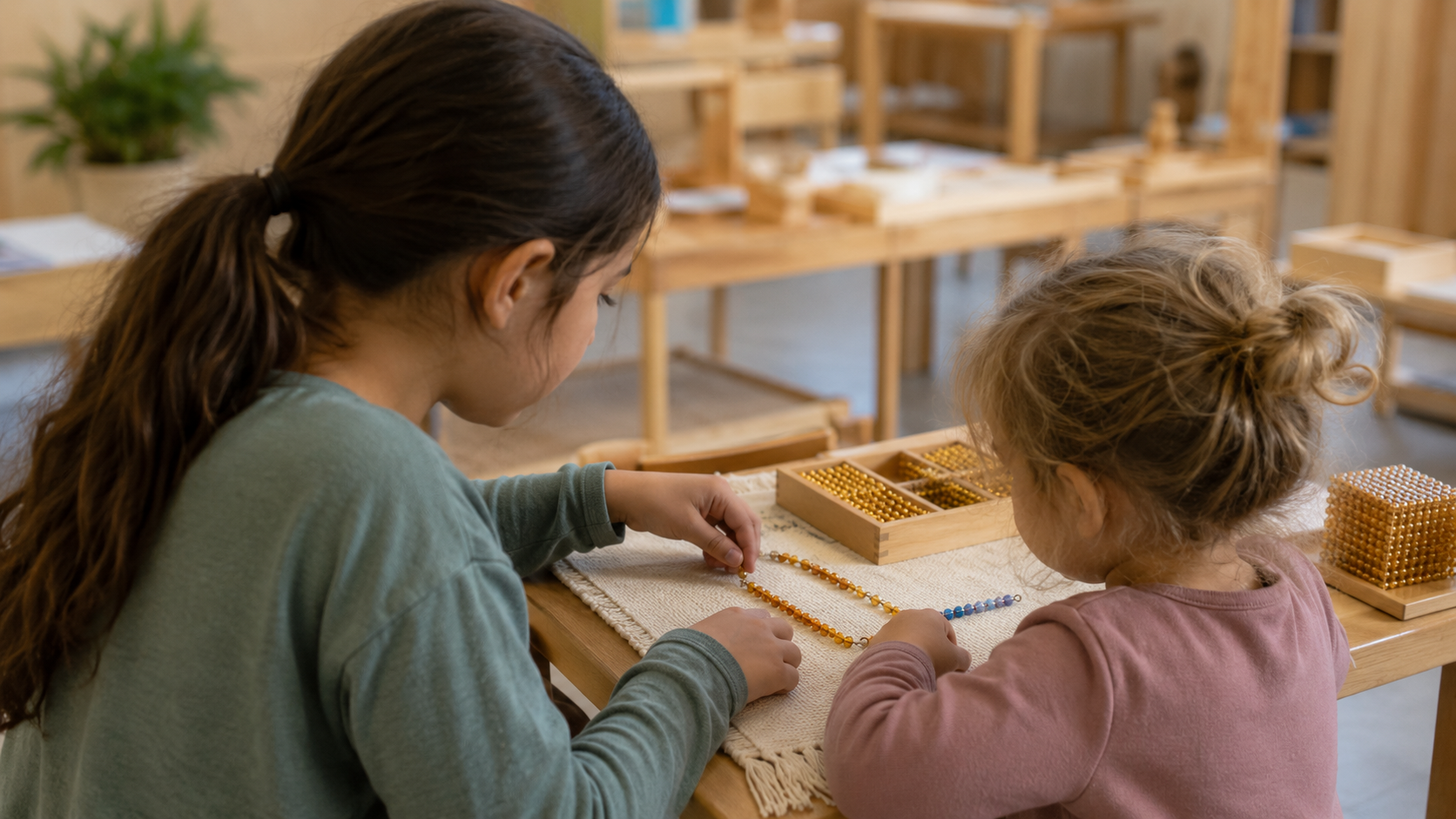
One hallmark of a Montessori education is the use of multi-age classrooms. At St. Peter's, our Nido, Children's House, and Elementary communities each span roughly three years — and that's entirely by design.
Primary classrooms bring together children ages 3 to 6, with preschool and kindergarten-aged children side by side. Elementary serves children 6 to 12. It's not what most families are used to — so what are the benefits of structuring a classroom this way? Read on.
Learning at an Individual Pace
Children in multi-age classrooms have a little more flexibility when it comes to mastering skills within a specific timeframe. Learning isn't linear — there are bursts of growth, plateaus, and even the occasional regression. In a mixed-age room, children can work at their own pace, without the pressure of keeping up with the whole group or being held back by it.
When ages range, everyone has someone to work with, whatever their skill level. No child feels left behind for finding a concept hard, and no child feels bored repeating something already mastered. Our guides develop deep knowledge across a wide range of developmental abilities, which leaves them well-equipped to tailor instruction to each individual child.
Building Stronger Relationships
Traditionally, children move to a new class — and a new teacher — every single year. That means new expectations, new routines, and a new relationship to build from scratch.
In a multi-age classroom, a guide has two or three years to truly know a child and their family. That depth lets them tailor both what they teach and how they teach it — they know how to hook a particular child into a lesson, and what kind of environment helps that child feel successful.
Families benefit too. When your child has the same guide for several years, the lines of communication grow strong, the home-to-school connection becomes seamless, and the biggest beneficiary is your child.
Mentors and Leaders
Spending multiple years in one community gives every child two special opportunities.
Younger children are surrounded by helpful peer mentors. Children often learn best from one another, and they seek it out naturally — watching older friends take on challenging work and feeling inspired to reach for it themselves.
Older children, meanwhile, get to practice leadership. In our classrooms you'll see them giving lessons, helping clean up a spill, or offering a comforting hand to a younger friend. And the beautiful part is that each child makes the shift from observer to leader in their own time.
Mirroring Real Life
Nowhere else in life are people sorted into groups of exactly the same age. In families, in workplaces, in communities, we live and work alongside people older and younger than ourselves — and we're richer for the mix of ideas and skills. Why not begin that experience in childhood?
Moving On
Eventually, every child transitions to a new community. It can feel bittersweet — but children are usually ready when the time comes. Montessori's groupings are built around the planes of development, with distinct milestones around ages 3, 6, and 12. The result is a rhythm that lets children feel at home in their community while preparing them to soar forward when the moment is right.
Want to see a multi-age classroom in action? Schedule a tour and come observe.