
The four planes of development
Dr. Maria Montessori observed that human beings develop in four roughly six-year stages, which she called the planes of development. Each plane has its own character, and each rests on the one before it.
The first plane: birth to six
This is the age of the absorbent mind, when children take in the world effortlessly and completely, language, movement, order, and culture, simply by living in it. It is a period of enormous growth in independence and a fierce drive to do things for oneself. St. Peter's Nido (infant and toddler) and Children's House programs are designed for exactly this stage, with prepared environments that let very young children move, explore, and master real, practical work.
The second plane: six to twelve
Elementary-aged children turn outward. Imagination and reasoning take center stage, and they hunger to understand how and why the world works. They become intensely social and morally aware, fascinated by fairness, big questions, and their place in the universe. Montessori Elementary answers this with sweeping, story-driven lessons and collaborative, hands-on exploration, the shape of our Elementary program.
The third and fourth planes
Adolescence (twelve to eighteen) and young adulthood (eighteen to twenty-four) carry the child toward independence, identity, and a meaningful role in the wider world. Understanding the whole arc helps parents see where their child is headed, even in the earliest years.
The absorbent mind
In the first six years, Montessori observed, the child's mind works unlike an adult's. Between birth and about age three, learning happens unconsciously; a child absorbs their native language, for example, without a single formal lesson. From three to six, that same absorptive power becomes more conscious and intentional: the child now wants to name, sort, refine, and perfect. This is why the early years are so precious, and why a rich, orderly, language-filled environment matters so much. It is also why St. Peter's weaves Spanish into daily life through Spanish-speaking staff and everyday exposure, since the young mind absorbs a second language far more readily than an older one will.
Sensitive periods
Within these stages, children pass through sensitive periods, windows of time when they are powerfully drawn to master a particular skill: order, language, movement, small objects, social behavior. During a sensitive period, a child will repeat an activity again and again with deep concentration and obvious joy, and learning that would be laborious at another age comes almost effortlessly. A great deal of Montessori practice is simply recognizing these windows and offering the right work while they are open. Miss the window and the skill can still be learned, but rarely with the same ease.
Why multi-age classrooms fit development
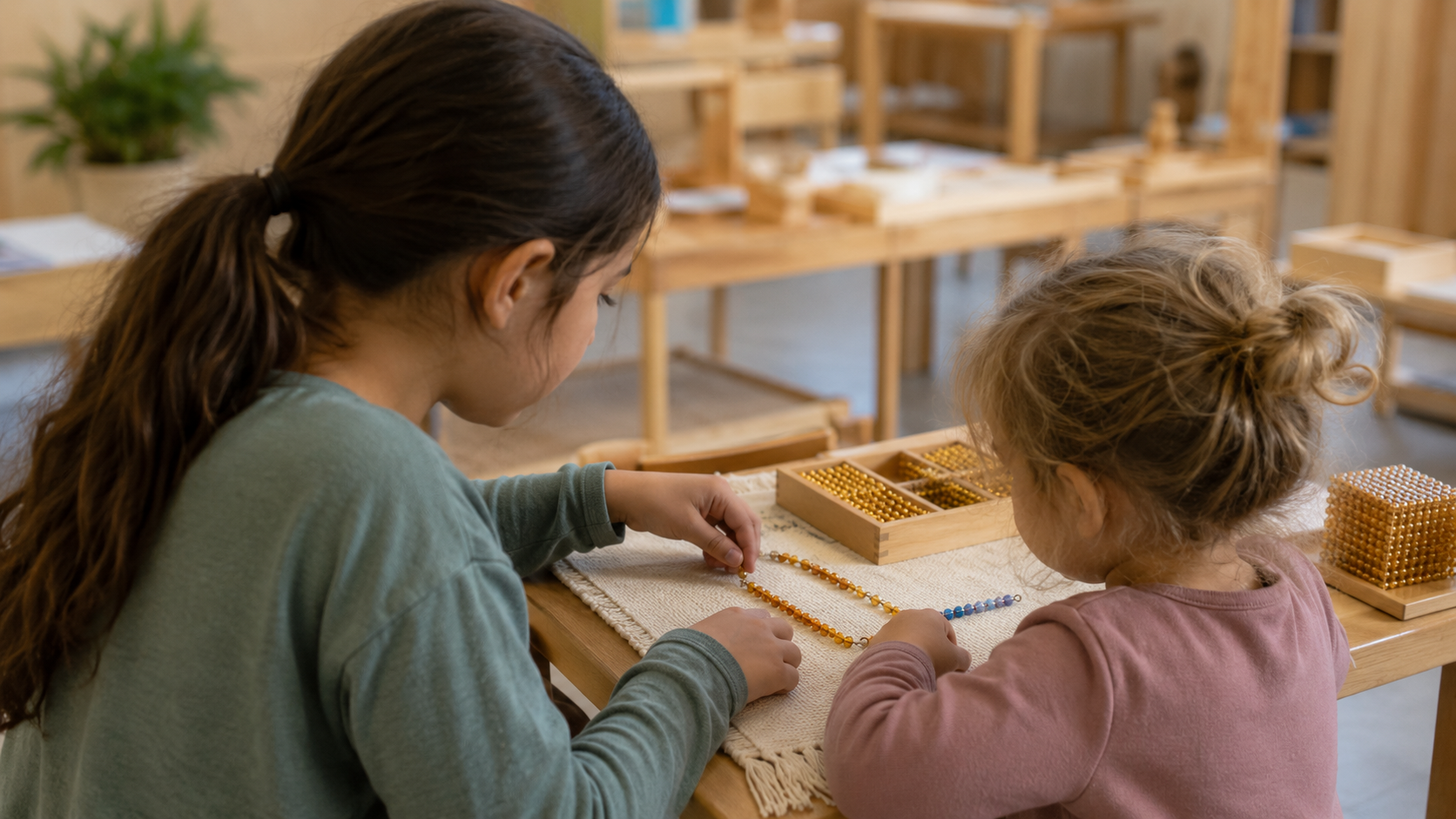
Because development is uneven and individual, Montessori groups children in mixed-age classes spanning about three years. A child is never held back by a single grade-level pace or pushed ahead of their readiness. Younger children are inspired by older ones; older children consolidate their learning by helping and leading. The result is a community that mirrors how children actually grow.
How St. Peter's is built around the child
Our programs form a continuous developmental path: Infant & Early Toddler (about three to eighteen months) and Nido II (about eighteen to thirty-six months) for the youngest children; Children's House (three to six) for the second half of the first plane; and Elementary (first through sixth grade) for the second plane. A low 1:10 ratio and a protected three-hour work cycle give each child the individual attention and uninterrupted time that genuine development requires. The point is never to accelerate childhood, but to honor it, to give each child what they need, exactly when they need it.