
Dr. Maria Montessori
"Within the child lies the fate of the future."— Dr. Maria Montessori
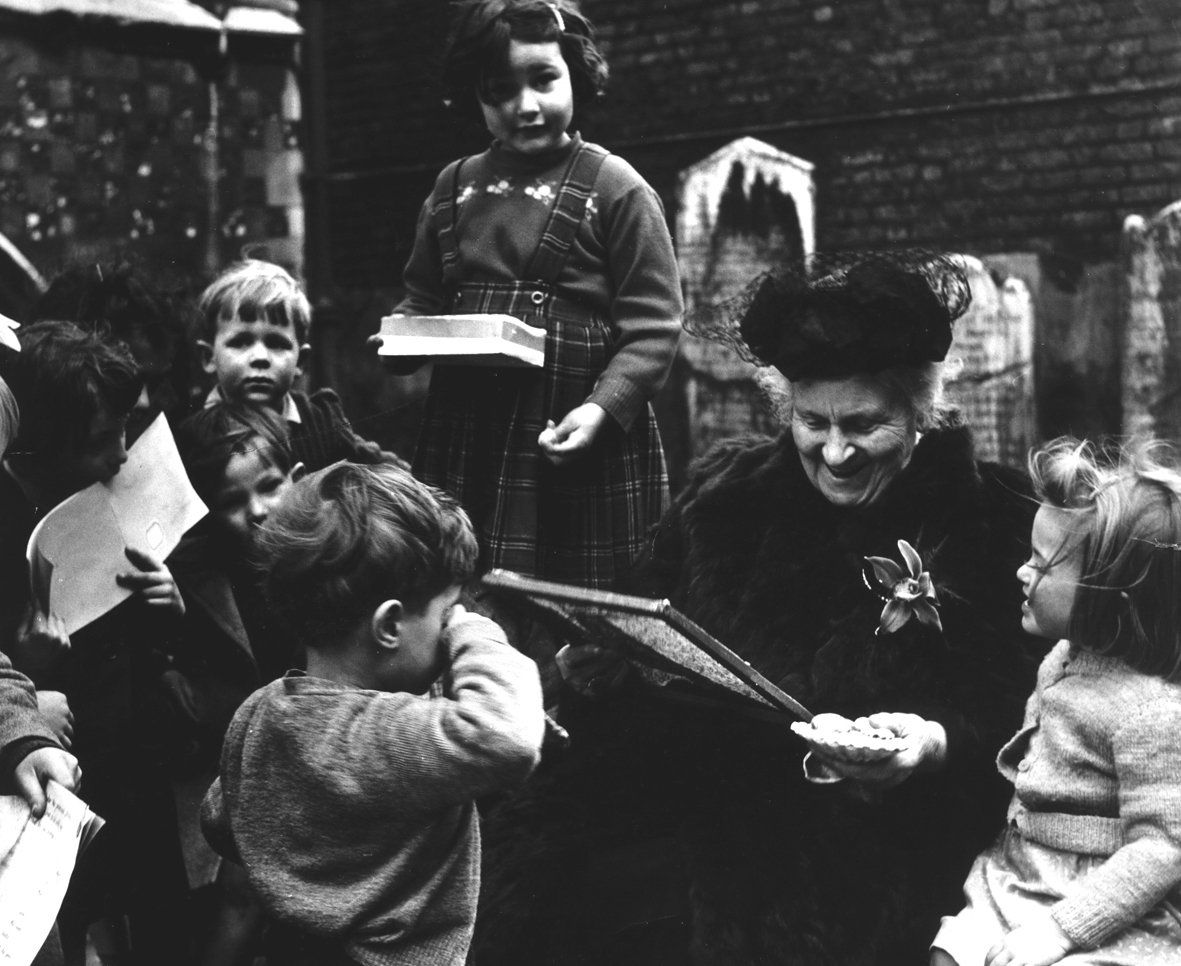
Dr. Maria Montessori was the first woman to practice medicine in Italy — a scholar of biology, psychiatry, anthropology, and medicine who graduated from the University of Rome in 1896. As a physician she grew fascinated by how children develop, observing that they construct their own personalities through their interaction with the environment, and that they learn best when free to choose and work with purposeful, self-correcting materials.
She studied children of every race and culture across many countries, recognizing the universal laws of human development, and continued her observations — widening and deepening her understanding — until her death in 1952. A devoted humanitarian, she was nominated three times for the Nobel Peace Prize for her work toward a more peaceful humanity.
Two principles at the foundation
Through her studies she named two foundations of Montessori pedagogy: the universal characteristics of the human child, and the child as a unique, unrepeatable, and admirable individual — to be unconditionally accepted as one of life's most marvelous expressions.
Historical timeline
1896
Graduates from the University of Rome School of Medicine to great public acclaim — the first woman in Italy to earn a medical degree. An early feminist, she represents Italy at the 1896 Women's Conference in Berlin, advocating for equal pay.
1896–1907
Working closely with children, she is appointed Director of the Scuola Ortofrenica. Through her emerging method, many of its students go on to pass standard testing with above-average scores.
1907
Opens the first Casa dei Bambini — "Children's House" — for children ages 3 to 6 in the San Lorenzo district of Rome.
1913
Makes her first visit to the United States; the Montessori Educational Association is founded by Alexander Graham Bell and his wife, Mabel.
1915
Draws international attention with her "glass house" classroom at the Panama-Pacific International Exposition in San Francisco, and leads a teacher-training course in the States.
1922
The Italian government appoints her a government inspector of schools.
1929
Founds the Association Montessori Internationale (AMI) in Amsterdam with her son, Mario, to preserve her educational principles.
1939
Travels to India to give teacher-training courses; she and Mario are detained there through World War II.
1947
Opens a training center in London while continuing her work in India.
1949–1951
Nominated for the Nobel Peace Prize three years running.
1952
Dies in the Netherlands, assured that her legacy would continue through the Association Montessori Internationale.

There's a place for your child here.
Tours are filling for the 2026–27 school year. Spend a morning on our campus and experience the difference an authentic Montessori education makes.
Schedule a Private Tour